Quantum computing venture funding
 |
| Quantum computing venture funding |
Quantum Computing Venture Funding: Unlocking the Future of Technology and Investment
Introduction
Quantum computing is no longer confined to science fiction or academic laboratories—it is rapidly becoming the next frontier of technological and economic transformation. Unlike classical computers, which process information in bits (0s and 1s), quantum computers use qubits, enabling them to solve problems that are practically impossible for even the most powerful supercomputers today.
This unprecedented computational capability has sparked a wave of venture capital (VC) investment in quantum computing startups around the globe. From quantum hardware and software development to quantum cryptography, materials science, drug discovery, and financial modeling, venture capitalists and institutional investors are pouring billions into the sector.
The surge in quantum computing venture funding is more than a technological gamble; it represents an investment in the foundations of the future digital economy. Just as the internet and artificial intelligence shaped previous decades, quantum computing promises to redefine industries, economies, and global competitiveness.
This article explores the rise of quantum computing venture funding, the investment landscape, major players, challenges, and the future outlook for entrepreneurs and investors.
Why Quantum Computing is Attracting Venture Capital
1. Transformational Potential Across Industries
Quantum computers promise breakthroughs in:
-
Drug discovery and genomics – Accelerating the design of new medicines and personalized therapies.
-
Materials science – Creating advanced materials for aerospace, semiconductors, and energy storage.
-
Climate modeling – Enabling accurate environmental simulations to tackle global warming.
-
Financial services – Optimizing trading algorithms, portfolio management, and risk modeling.
-
Cybersecurity – Quantum encryption to secure data in the age of quantum attacks.
2. First-Mover Advantage
Investors are eager to back early movers in the sector. Just as early bets on internet companies like Amazon, Google, and Facebook paid off massively, today’s quantum startups may become tomorrow’s trillion-dollar giants.
3. Government Support and National Security Concerns
Quantum computing is also a geopolitical priority. The U.S., EU, and China are heavily funding quantum research, creating fertile ground for venture-backed startups. National security implications in cryptography and AI make quantum a top policy concern.
4. Technological Breakthroughs
Advances in quantum hardware (superconducting qubits, trapped ions, photonics) and software platforms have made commercial progress more feasible, convincing investors that the sector is ready for commercialization.
 |
| Quantum computing venture funding |
Global Trends in Quantum Venture Funding
Record Investment Levels
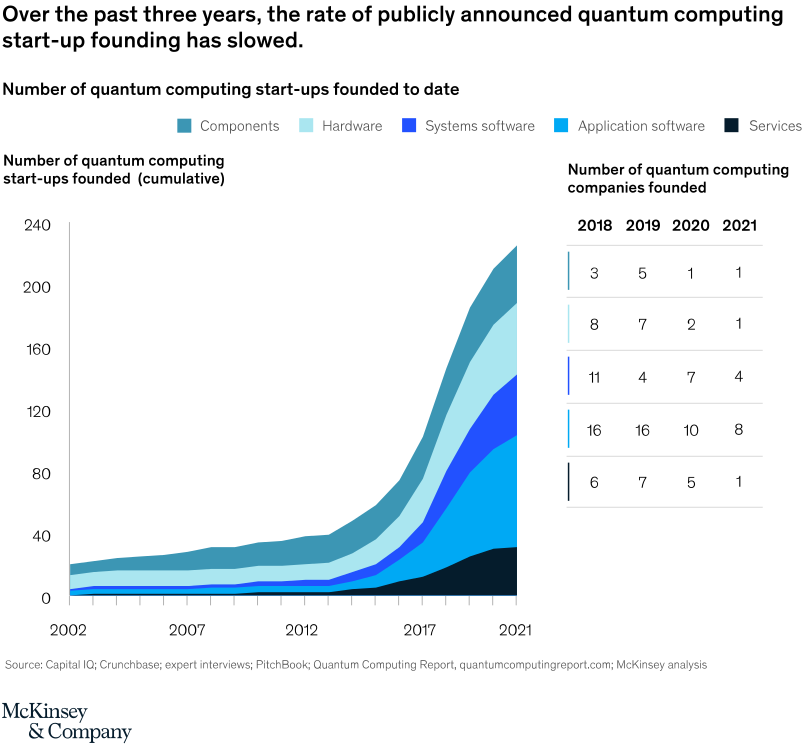
According to recent reports, quantum startups attracted over $3.5 billion in private capital in 2024, up from less than $500 million in 2018. This exponential growth underscores rising investor confidence.
Regional Highlights
-
United States: Home to major VC activity, led by firms like Andreessen Horowitz, Sequoia Capital, and Quantum Valley Investments.
-
Europe: Strong activity in Germany, the UK, and the Netherlands, focusing on quantum communication and cryptography.
-
China: Backed by state-linked venture funds, Chinese startups are rapidly scaling in hardware.
-
India & Israel: Emerging hubs for quantum software and algorithm development.
Maturity of the Ecosystem
Quantum funding is diversifying beyond hardware into software layers, middleware, quantum cloud services, and developer ecosystems—a sign that the sector is transitioning from research-heavy to application-driven.
Notable Quantum Startups and Their Funding Success
-
Rigetti Computing – A U.S.-based company working on superconducting qubit systems, raised over $350 million from investors like DCVC.
-
IonQ – Pioneering trapped-ion technology, went public via SPAC in 2021 and is backed by Amazon and Google.
-
PsiQuantum – Developing a photonics-based quantum computer, raised more than $700 million with backing from BlackRock and Microsoft.
-
Quantinuum – A joint venture of Honeywell and Cambridge Quantum, heavily invested in quantum software and encryption.
-
Xanadu Quantum Technologies – Canadian startup working on photonic quantum computing, raised $250 million from Tiger Global and BDC Capital.
-
Zapata AI (formerly Zapata Computing) – Developing quantum algorithms for industry, raised $100M+ from VCs and corporate partners.
-
Terra Quantum – Swiss startup bridging classical and quantum computing, with multi-million-dollar funding rounds.
-
Qnami, QuEra Computing, and Multiverse Computing – Smaller but fast-growing startups focusing on specialized quantum applications in finance and cybersecurity.
 |
| Quantum computing venture funding |
Types of Investors Driving the Boom
Venture Capital Firms
Top-tier VC firms see quantum as a high-risk, high-reward investment, similar to AI a decade ago. Quantum Valley Investments in Canada has been particularly influential.
Corporate Investors
Tech giants like Google, IBM, Amazon, Microsoft, and Intel are not only building their own quantum computers but also investing in quantum startups as strategic bets.
Sovereign Wealth Funds and Governments
Sovereign funds from the Middle East (Saudi PIF, Mubadala) and Asia are backing global quantum startups. Simultaneously, governments are creating public-private partnerships to accelerate commercialization.
University Spin-offs
Many startups originate from university research labs, supported by university venture arms, tech transfer offices, and early-stage funding.
Challenges Facing Quantum Venture Funding
While the funding surge is promising, quantum startups face significant hurdles:
-
Long Development Timelines – Unlike SaaS or fintech startups, quantum firms often require a decade or more to commercialize. This tests investor patience.
-
High R&D Costs – Quantum hardware requires specialized labs, cryogenics, and high-end infrastructure, leading to capital-intensive operations.
-
Talent Shortages – Quantum computing requires physicists, mathematicians, and engineers with rare expertise, creating a hiring bottleneck.
-
Uncertain Commercial Models – While the technology holds promise, clear business models are still emerging, and not all startups will succeed.
-
Geopolitical Risks – Export controls, national security concerns, and tech wars between the U.S. and China can disrupt investment flows.
Benefits of the Quantum Funding Wave
-
Accelerated Research to Market Pathways – Venture funding helps move quantum innovation from academia to commercialization.
-
Job Creation in Deep Tech – Quantum startups create opportunities for scientists and engineers in cutting-edge fields.
-
Cross-Industry Applications – Quantum solutions could disrupt pharma, energy, finance, logistics, and climate tech.
-
Geopolitical Leadership – Countries investing heavily in quantum startups gain a strategic advantage in future technology races.
-
Innovation Spillovers – Breakthroughs in quantum research often spill over into adjacent fields like materials science and AI.
The Role of Governments in Supporting Venture Capital
Governments worldwide are recognizing that quantum computing is too important to be left solely to private capital. Programs like:
-
U.S. National Quantum Initiative Act (over $1.2 billion committed).
-
EU Quantum Flagship Program (€1 billion funding).
-
China’s National Quantum Strategy (multi-billion-dollar investment).
-
India’s National Quantum Mission (₹6000+ crore allocated).
These initiatives create synergy with venture capital funding, ensuring startups have both private and public capital support.
 |
| Quantum computing venture funding |
Future Outlook: What Lies Ahead for Quantum Funding?
-
Quantum Cloud Services – Similar to AWS for classical computing, quantum cloud platforms will become a key growth area.
-
Hybrid Quantum-Classical Solutions – Startups will build tools that integrate quantum algorithms with existing classical computing power.
-
Quantum AI Synergy – Combining AI and quantum computing will attract significant venture capital interest.
-
More IPOs and SPACs – Following IonQ’s lead, more quantum startups may go public, giving investors liquidity.
-
Sustainability and Climate Tech Applications – Quantum models will play a major role in optimizing renewable energy and reducing carbon emissions, drawing ESG-focused capital.
-
Democratization of Quantum Access – Startups enabling developers, students, and enterprises to experiment with quantum algorithms will become the “Shopify of quantum computing.”
 |
| Quantum computing venture funding |
The Final Take:- Quantum Computing Venture Funding.
The quantum computing venture funding boom is one of the most exciting trends in today’s global tech ecosystem. While the risks are significant—ranging from long commercialization timelines to technical uncertainties—the potential rewards are transformational.
Venture capital, corporate investors, and governments are together fueling a race to unlock the power of qubits. Whether it’s discovering life-saving drugs, building unbreakable encryption, or solving global climate challenges, quantum startups hold the promise of shaping the 21st-century economy.
For entrepreneurs, the message is clear: the quantum era has begun, and those who innovate now will define the future. For investors, quantum represents not just an asset class, but a stake in the next computing revolution.
✅ Word Count: ~1,820


Comments
Post a Comment
Friendly & Inviting:
We'd be happy to hear your thoughts — feel free to share a comment below!
With Moderation Reminder:
Comments are moderated. Your comment will appear once approved.
With Community Guidelines:
Please be respectful and stay on topic. Spam and rude comments will be deleted.